Study › Technician › T6A

T6A

ELECTRONIC AND ELECTRICAL COMPONENTS

Fixed and variable resistors; Capacitors; Inductors; Fuses; Switches; Batteries

Drill results are kept in this browser. Log in to keep them on your account and get a study plan.

T6A011 of 11

What electrical component opposes the flow of current in a DC circuit?

Why A resistor's whole job is to oppose current flow, and that opposition is measured in ohms. Ohm's law, I = E/R, shows that for a fixed voltage, more resistance means less current. In a DC circuit the resistor is the component that sets or limits current and drops voltage.
Watch out An inductor opposes a change in current, but once DC settles to a steady value the inductor looks like a plain piece of wire with almost no opposition. A transformer only works with changing (AC) current, and an inverter converts DC to AC.
Resistor = resists. Ohms oppose current in DC; inductors only fight changes, not steady DC.
HamSandwich explanation, first draft. The question and answers are the NCVEC text.
T6A022 of 11

What type of component is often used as an adjustable volume control?

Why A potentiometer is a variable resistor with a movable wiper that taps off a portion of the resistance, so turning the knob changes the voltage divided down to the next stage. That is exactly what a volume control does: it varies how much of the audio signal is passed along. The name comes from dividing a potential (voltage).
Watch out A fixed resistor has one unchangeable value, so it cannot adjust anything; a power resistor is just a fixed resistor built to dissipate heat, and a transformer couples AC between windings rather than providing a knob.
Pot = knob you turn. Potentiometer for volume, fixed resistors don't move.
HamSandwich explanation, first draft. The question and answers are the NCVEC text.
T6A033 of 11

What electrical parameter is controlled by a potentiometer?

Why A potentiometer is a variable resistor: it has a resistive element with a wiper that slides along it, so turning the shaft changes the resistance between the wiper and the ends. Volume controls and tone controls are common examples. Because changing resistance in a circuit changes the voltage division, a pot is often used to set a variable voltage, but the parameter it actually varies is resistance.
Watch out Variable inductance comes from a tuned coil or roller inductor, and variable capacitance from a variable capacitor such as the air-spaced type in older tuners; neither is what a pot adjusts.
Pot = potentiometer = variable resistor. The knob moves a wiper along a resistive strip.
HamSandwich explanation, first draft. The question and answers are the NCVEC text.
T6A044 of 11

What electrical component stores energy in an electric field?

Why A capacitor is two conductive plates separated by an insulating dielectric. When voltage is applied, charge builds on the plates and the energy is stored in the electric field between them, with the amount given by E = 1/2 CV^2. Capacitance is measured in farads, and larger plate area or thinner dielectric means more capacitance.
Watch out The inductor is the tempting swap: it stores energy too, but in a magnetic field around its coil, not an electric field. A resistor stores nothing, it converts electrical energy to heat.
Capacitor = Charge = Electric field; Inductor = Iron core = Magnetic field.
HamSandwich explanation, first draft. The question and answers are the NCVEC text.
T6A055 of 11

What type of electrical component consists of conductive surfaces separated by an insulator?

Why A capacitor is built from two conductive plates (or foils) separated by an insulating layer called the dielectric. Because no current flows through the dielectric, charge piles up on the plates and energy is stored in the electric field between them. That stored charge per volt is the capacitance, measured in farads.
Watch out A resistor and a potentiometer are both continuous conductive paths that oppose current and turn energy into heat; an oscillator is a whole circuit that generates a signal, not a two-terminal component.
Two plates plus an insulator between them = capacitor. Conductor, insulator, conductor is the capacitor sandwich.
HamSandwich explanation, first draft. The question and answers are the NCVEC text.
T6A066 of 11

What type of electrical component stores energy in a magnetic field?

Why An inductor is a coil of wire; when current flows through it, it creates a magnetic field around the turns, and that field stores energy. Because the field opposes changes in current, inductors resist sudden current changes and their opposition to AC (inductive reactance) rises with frequency. Energy stored is E = 1/2 L I squared, where L is inductance in henrys.
Watch out The capacitor is the natural mix-up: it also stores energy, but in an electric field between two plates separated by an insulator, and it opposes changes in voltage instead of current.
Coil = magnetic field = inductor; plates = electric field = capacitor. Current makes magnetism, voltage makes charge.
HamSandwich explanation, first draft. The question and answers are the NCVEC text.
T6A077 of 11

What electrical component is typically constructed as a coil of wire?

Why An inductor stores energy in a magnetic field, and the easiest way to concentrate that field is to wind wire into a coil, often around an air, ferrite or iron core. Current through the turns creates the magnetic field, and the coil's opposition to changes in current is its inductance, measured in henries. So a coil of wire is literally the physical form of an inductor.
Watch out A capacitor is the other energy storage component, but it stores energy in an electric field between two plates separated by an insulator, not in a coil. Transistors and diodes are semiconductors, not wound wire.
Coil = inductor = magnetic field. Plates = capacitor = electric field.
HamSandwich explanation, first draft. The question and answers are the NCVEC text.
T6A088 of 11

What is the function of an SPDT switch?

Why Switch names read as poles and throws: SPDT is Single Pole, Double Throw. The single pole is the one common input contact, and the two throws are the two positions it can connect to, so one circuit gets routed to either of two others.
Watch out The choice about simply opening or closing one circuit describes an SPST (single throw only), and the choice with two circuits each switched between two others is a DPDT.
Poles = how many circuits move; throws = how many destinations. SP = 1 common, DT = 2 choices.
HamSandwich explanation, first draft. The question and answers are the NCVEC text.
T6A099 of 11

What type of switch is represented by component 3 in figure T-2?
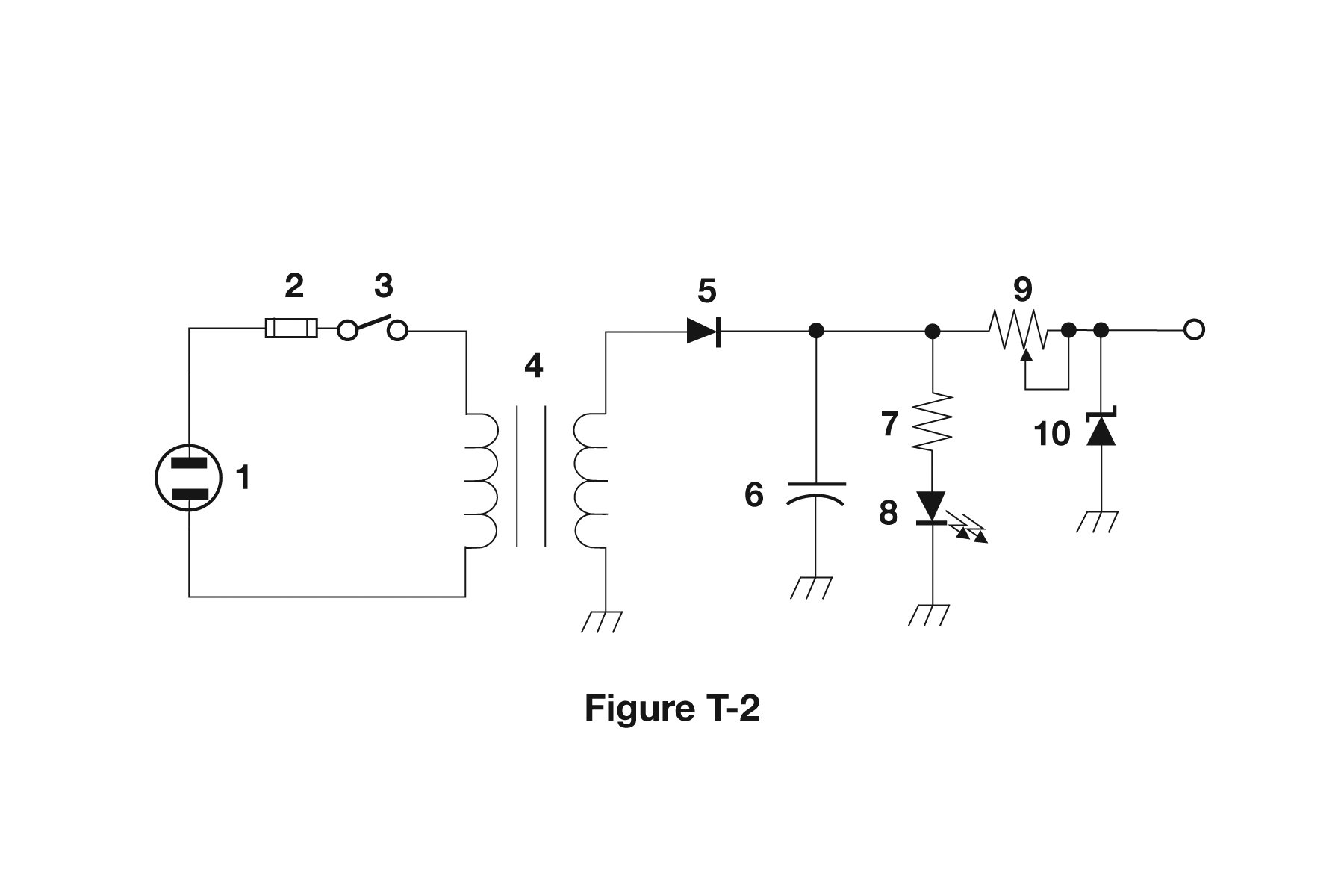
Figure T-2 from the NCVEC question pool
Why Switch names count poles (how many separate circuits the switch controls) and throws (how many contacts each pole can connect to). Component 3 in Figure T-2 shows one moving blade touching a single fixed contact, so it is one pole with one throw: a simple on/off switch. That single-pole single-throw arrangement is the most common switch symbol in schematics.
Watch out A single-pole double-throw switch would be drawn with one blade but two fixed contacts to select between, and any double-pole type would show two blades tied together by a dashed line.
Count the blades for poles, count the contacts each blade can touch for throws. One and one equals SPST.
HamSandwich explanation, first draft. The question and answers are the NCVEC text.
T6A1010 of 11

Which of the following battery chemistries is rechargeable?

Why All three listed chemistries are secondary (rechargeable) cells, meaning their internal chemical reaction can be reversed by pushing current back in. Nickel-metal hydride cells (about 1.2 V each) are common in AA-size rechargeables and older handheld packs, lithium-ion cells (about 3.6 to 3.7 V) power most modern HTs, phones and laptops, and lead-acid batteries (about 2 V per cell, 12 V typical) are the standard for vehicles, solar storage and emergency station power.
Watch out The tempting mistake is picking only one, usually lithium-ion, because it is the most familiar rechargeable. The non-rechargeable (primary) chemistries the pool cares about are carbon-zinc and lithium primary cells, which are not on this list.
Rechargeable list: NiMH, Li-ion, lead-acid. Primary (throw away): carbon-zinc and lithium metal.
HamSandwich explanation, first draft. The question and answers are the NCVEC text.
T6A1111 of 11

Which of the following battery chemistries is not rechargeable?

Why Batteries split into primary (single use) and secondary (rechargeable) types. Carbon-zinc cells, the classic cheap dry cells, are primary cells: the zinc case is consumed chemically and the reaction cannot be usefully reversed, so trying to recharge them risks leaking or rupture. Nickel-cadmium, lead-acid and lithium-ion are all secondary chemistries designed for repeated charge and discharge cycles.
Watch out Nickel-cadmium tempts people because it is an older technology, but NiCd was the standard rechargeable pack in handheld radios for decades, and lead-acid is the rechargeable battery in every car.
Carbon-zinc is the throwaway flashlight cell. If it powers a car, a handheld or a laptop, it recharges.
HamSandwich explanation, first draft. The question and answers are the NCVEC text.
Tram 1481 Dual Band Base AntennaSponsored · View on Amazon →Diamond X50A Dual Band Base AntennaSponsored · View on Amazon →
← T5D All groups T6B →